
Your notes become a question bank.
Bottsy reads the Obsidian notes you already keep and turns the facts you tag into Bitts — real exam questions and atomic flashcards that stay linked to the note they came from, are checked before they reach you, and arrive on a spaced-repetition schedule.
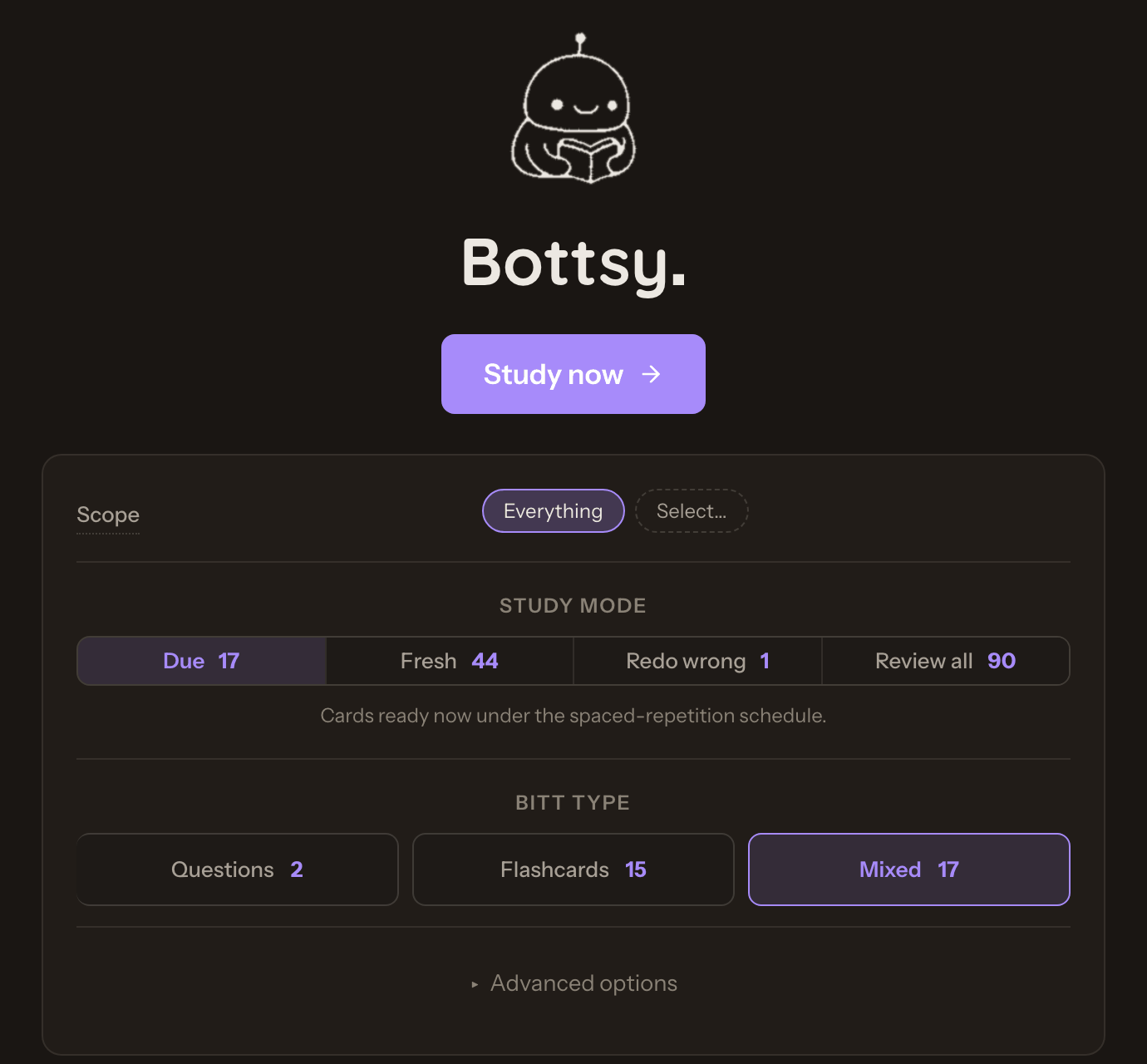
The app as it runs today · one button, and whatever is due
Real Bitts from the maker’s own deck
From note to question bank in four steps
Your vault is the source of truth. Bottsy reads it and never rewrites your notes — the words stay exactly as you wrote them.
Tag a fact
Add a small marker to any note — <!-- bottsy: flashcard --> — for a flashcard, cloze, diagram or exam question. It hides inside a comment; your prose is untouched.
Review the proposal
A sync check proposes new Bitts from what you tagged, each with an advisory AI quality note. Nothing enters your deck until you approve it, and a safety copy of the database is taken first.
Study what is due
Press Study now. The scheduler serves whatever is due, and new Bitts graduate through short learning steps. Answer by clicking, typing or speaking.
Keep the bank honest
Flag a weak Bitt mid-study and the quality system takes it from there — audits, reviews, and new audit rules learned from your feedback.
Questions a flashcard app cannot ask
Five options, one single best answer, in the style of MRCPsych and MRCP papers. This is the part word-flip flashcard tools have no concept of.
- A proper clinical vignette — a patient, a decision, a reason to think.
- Five plausible options. An implausible distractor is treated as a quality failure, not a freebie.
- A first-principles explanation that argues why the right answer is right — not one that just restates it.
- Approved by you before it counts. Vault questions are hand-approved and stored verbatim; where you want more, Bottsy can generate them with your own Anthropic key.
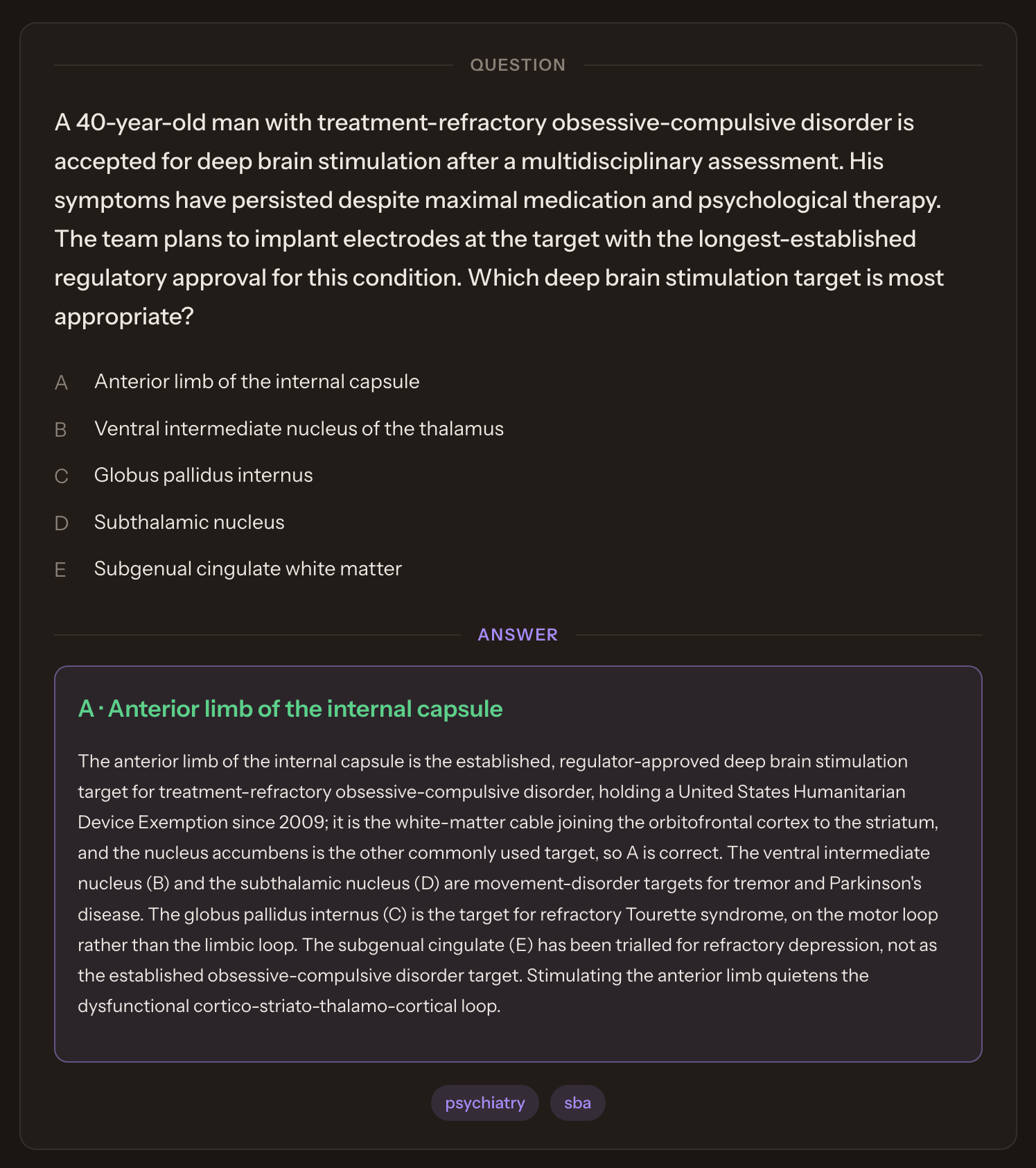
Question 22 of the maker’s deck, exactly as the app renders it
Every Bitt knows the note it came from
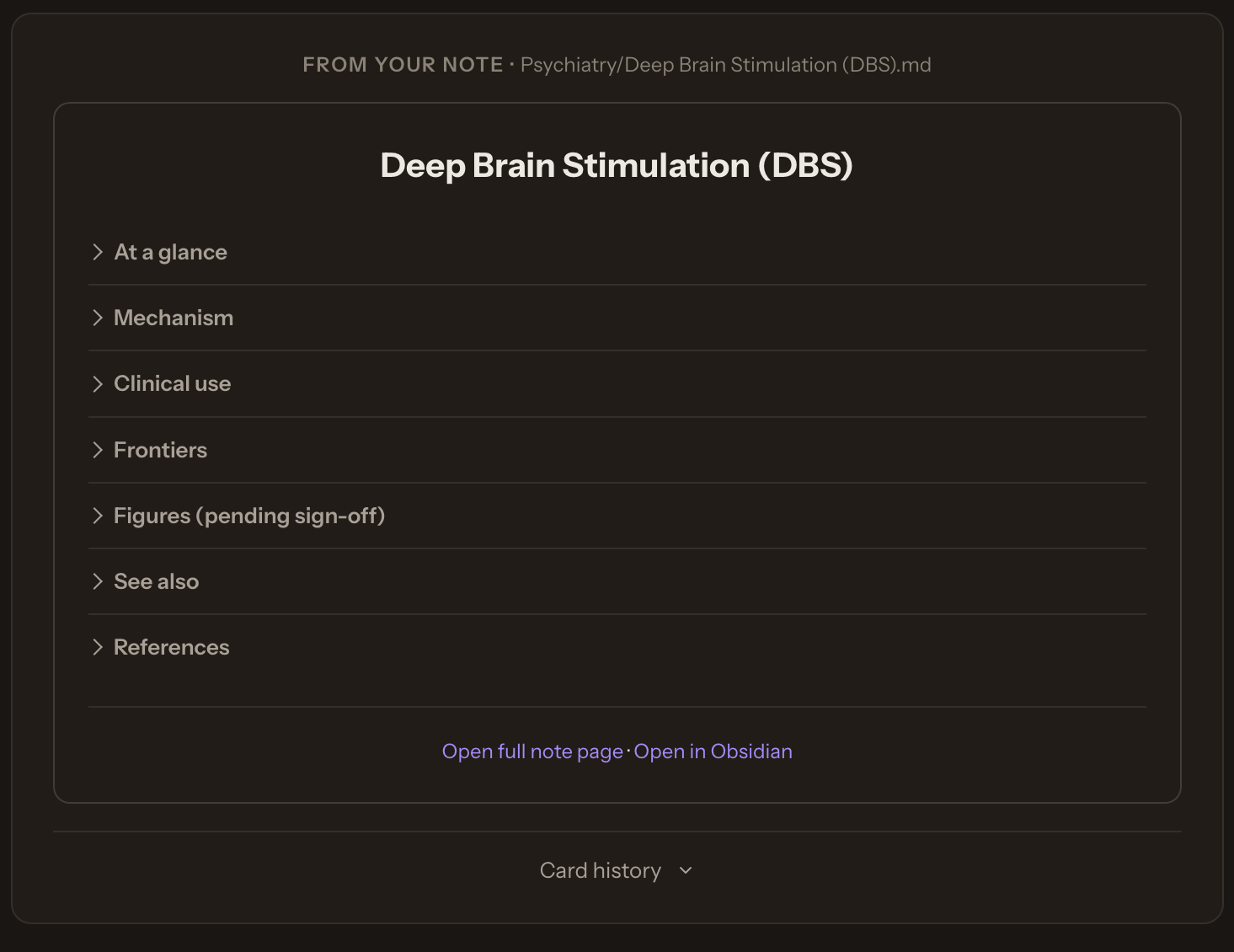
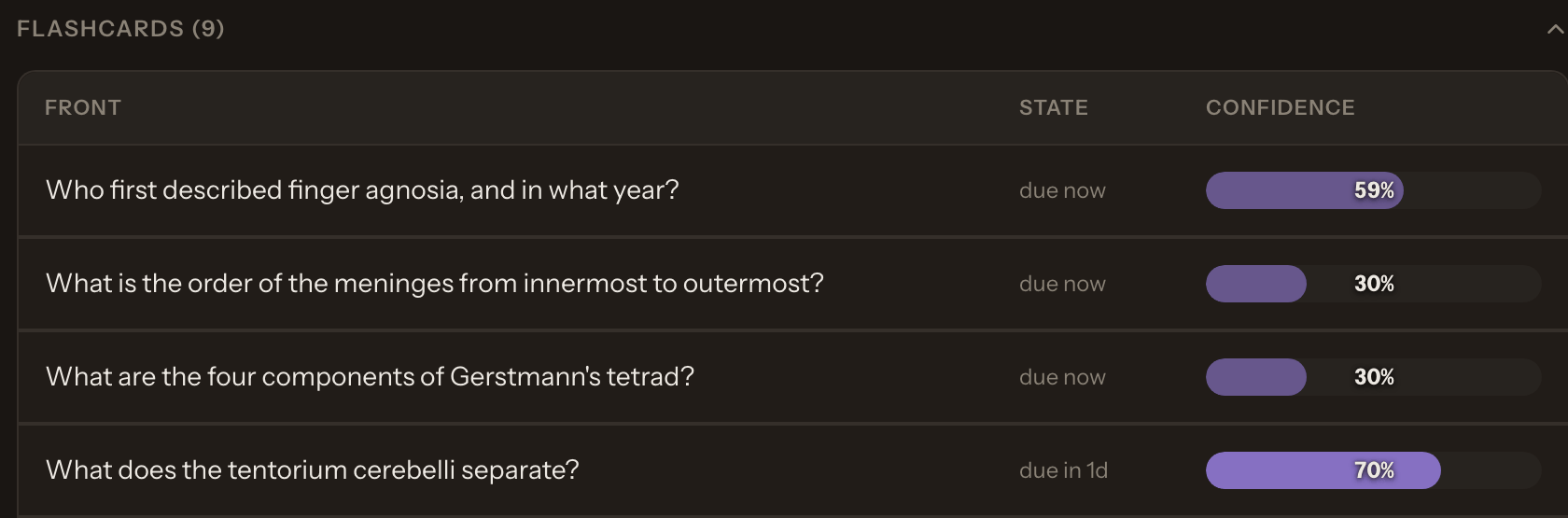
Cards are not orphans in a deck. Each one carries the identity of the note that made it, and the link survives edits, renames and moves.
- The note, on the card. Open the source note from any question — or jump straight into Obsidian.
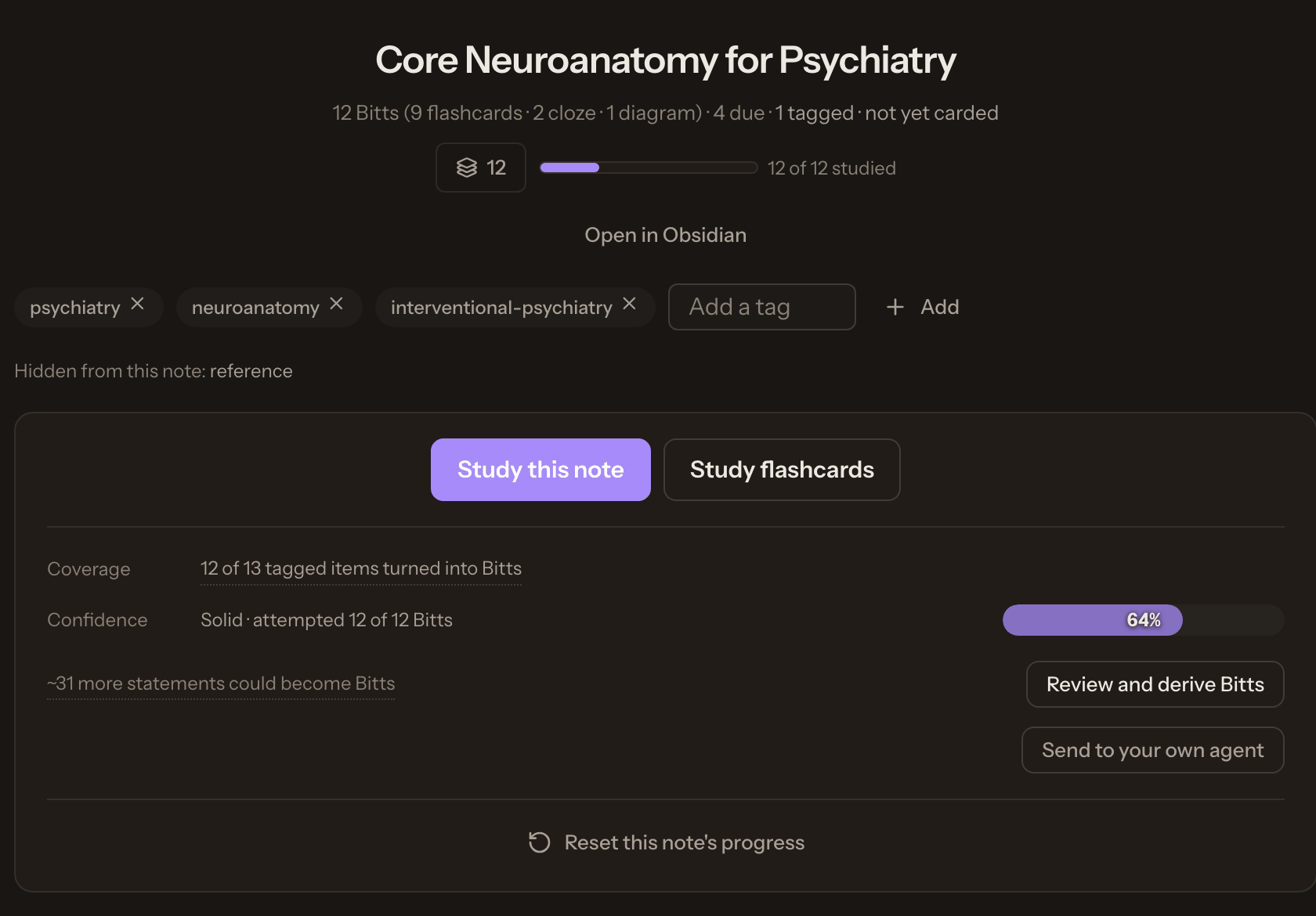
- Coverage you can see. Each note page shows how much of what you tagged has become Bitts, and what could still become one.
- Confidence from evidence. Built from your actual review history, not self-rating.
Atomic by rule, not by discipline
One fact per card is a rule the system enforces, not advice it hopes you follow.
- Hard word limits. Question-and-answer cards are capped at 25 words; cloze blanks are shorter still.
- Cloze where it matters. Drug names, doses, percentages and diagnostic thresholds become fill-in-the-blank cards as a matter of policy.
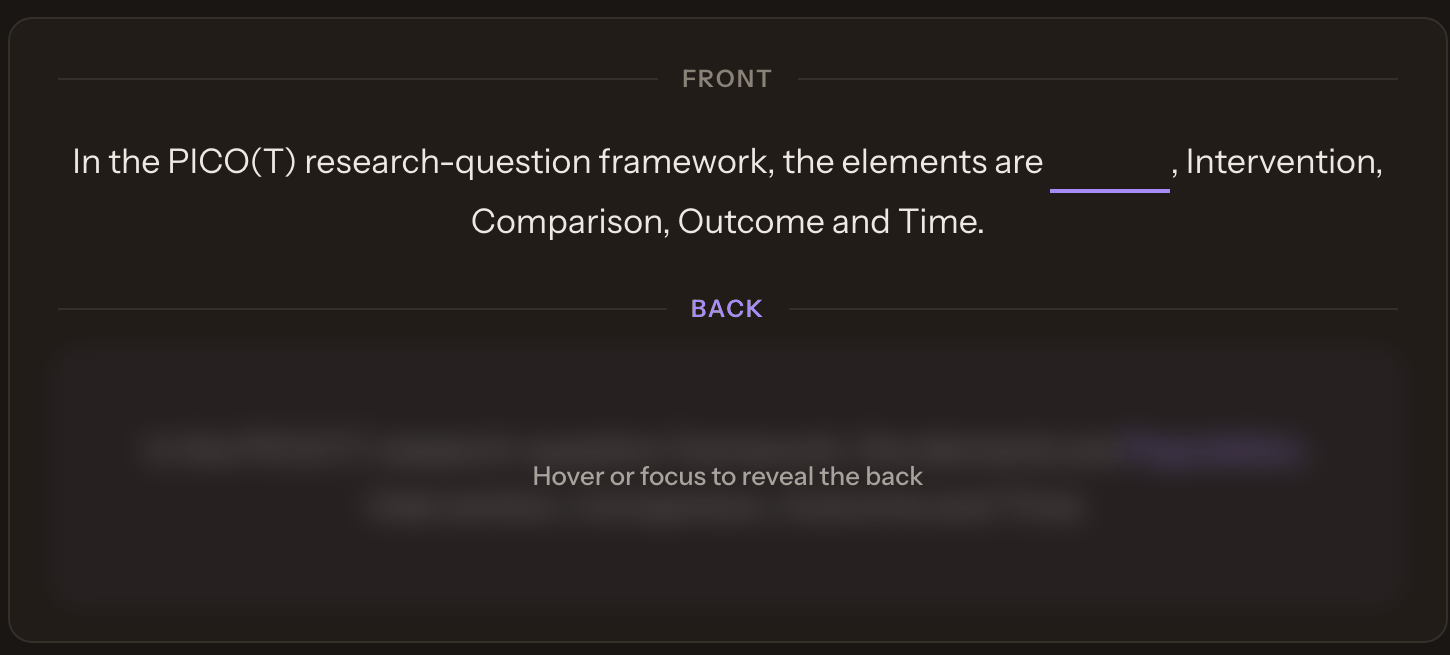
- Recall kept honest. The back of a card stays blurred until you commit — hover or focus to reveal.
Checked before you ever study it
Generated content can be wrong, and even your own cards age. Bottsy treats checking as a first-class feature — a card earns its place in your deck.
Advisory AI review
Every Bitt proposed from your vault gets an advisory quality note at proposal time — weak distractors, giveaway fronts, multi-fact cards.
Your approval
Propose, then promote. You review the proposal and decide what enters the deck; nothing is added behind your back.
Mechanical audit
Deterministic rule checks on every Bitt — option counts, answer letters, duplicates, missing explanations. Free, instant, and never wrong.
Rules learned from you
Flag a Bitt and the reason can become a new audit rule, so the same weakness is caught automatically from then on.
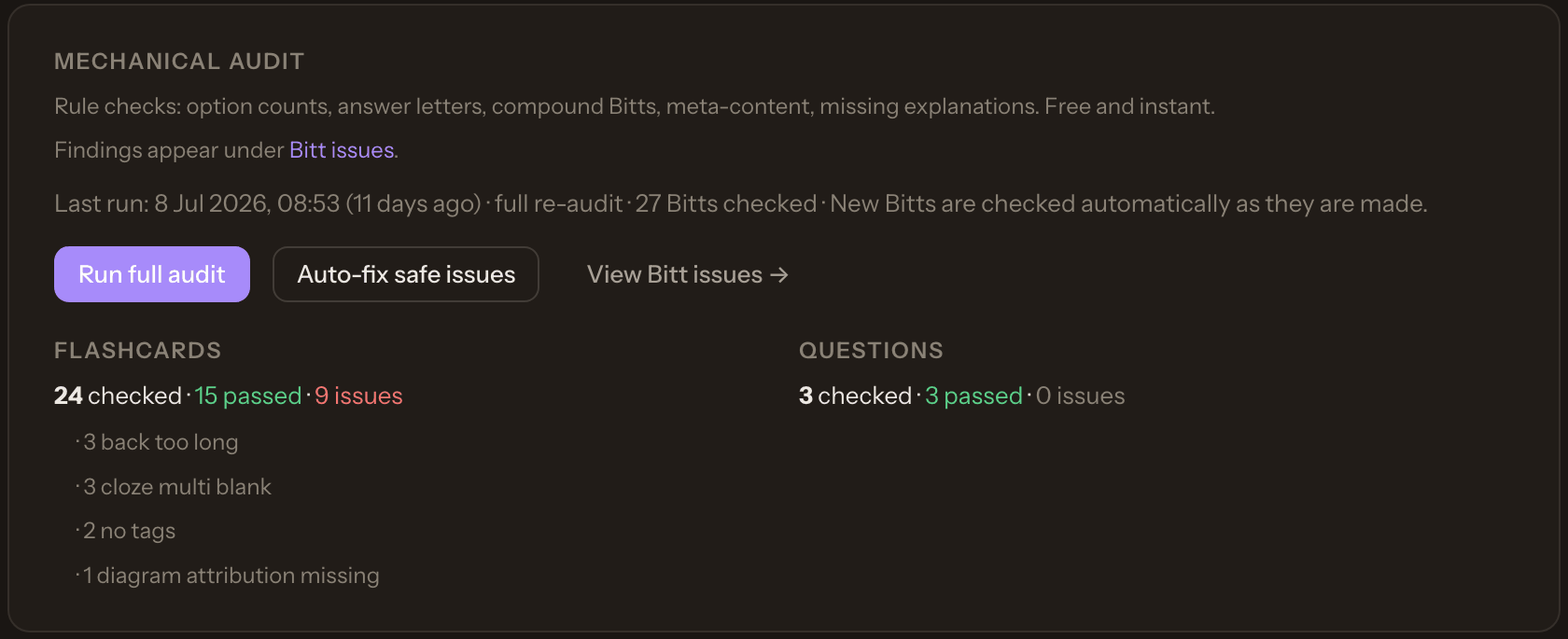
The audit, run against the maker’s deck · findings are itemised, not hidden
Evidence, not encouragement
Bottsy runs standard SM-2 spaced repetition with two short learning steps. No streaks, no badges, no mystery algorithm — and no “great job!”.
- Position, stated plainly. Coverage and confidence per note, computed from your actual attempts.
- A due forecast, so next week’s workload is visible before it lands.
- Struggling cards return in minutes; known cards retreat to expanding intervals.
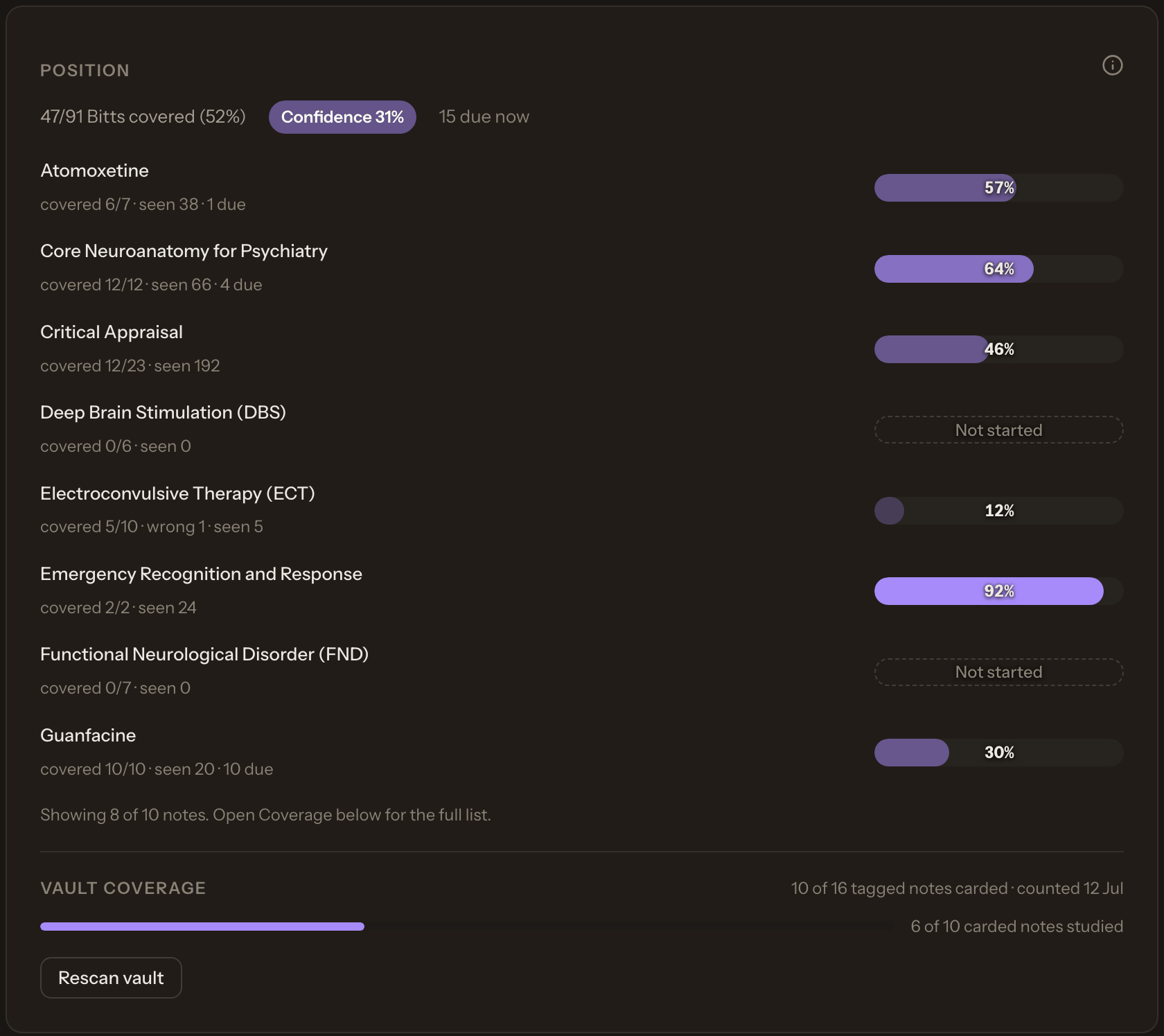
Insights · the numbers as they stand, including the unflattering ones
Say it out loud
Answer by voice and Whisper transcribes you; have questions read aloud with ElevenLabs. A viva practice mode asks one open question at a time and marks what you covered and what you missed. All of it is off by default, opt-in per session — and every workflow has a full text-only path.
Local-first, by design
A small lexicon
Bottsy has exactly two pieces of jargon, and both are load-bearing.
One piece of study material — a single exam question, flashcard, cloze or diagram. Every Bitt traces back to where it came from.
A combination of notes and tags you revise as one — an exam block, say — with its own coverage and confidence figures.
Built by a doctor who studies this way
Active recall and spaced repetition have a stronger evidence base than almost any other way to study. The limitation has never been the method — it is that question banks only cover what someone else chose to write.
Bottsy is made by a UK psychiatry doctor, working from the notes he already keeps: the exam material, and everything the banks never reach — the specialty interest that came from a paper, the guideline worth understanding from first principles.
Bottsy is in active development.
It is a personal tool first, in daily use by the person making it. If the way it works matches the way you study, say hello and we’ll keep you posted.
Register interest